

Vascular Dementia: Symptoms, Causes, Stages and Care
Vascular dementia is the second most common form of dementia in the UK, yet many families know very little about it until a diagnosis arrives. Here’s what it actually means, and what to expect.
If someone you love has just been diagnosed with vascular dementia, you’re probably trying to make sense of a great deal of information very quickly. What does this type of dementia actually do to the brain? How is it different from Alzheimer’s? And what can you realistically expect over the coming months and years?
It’s a lot to take in, especially at a moment when everything feels uncertain. This guide covers what families and carers need to know: from what vascular dementia is and why it behaves differently from other dementias, to what daily life looks like and where to find support. We’ve done the reading so you don’t have to.
What is vascular dementia?
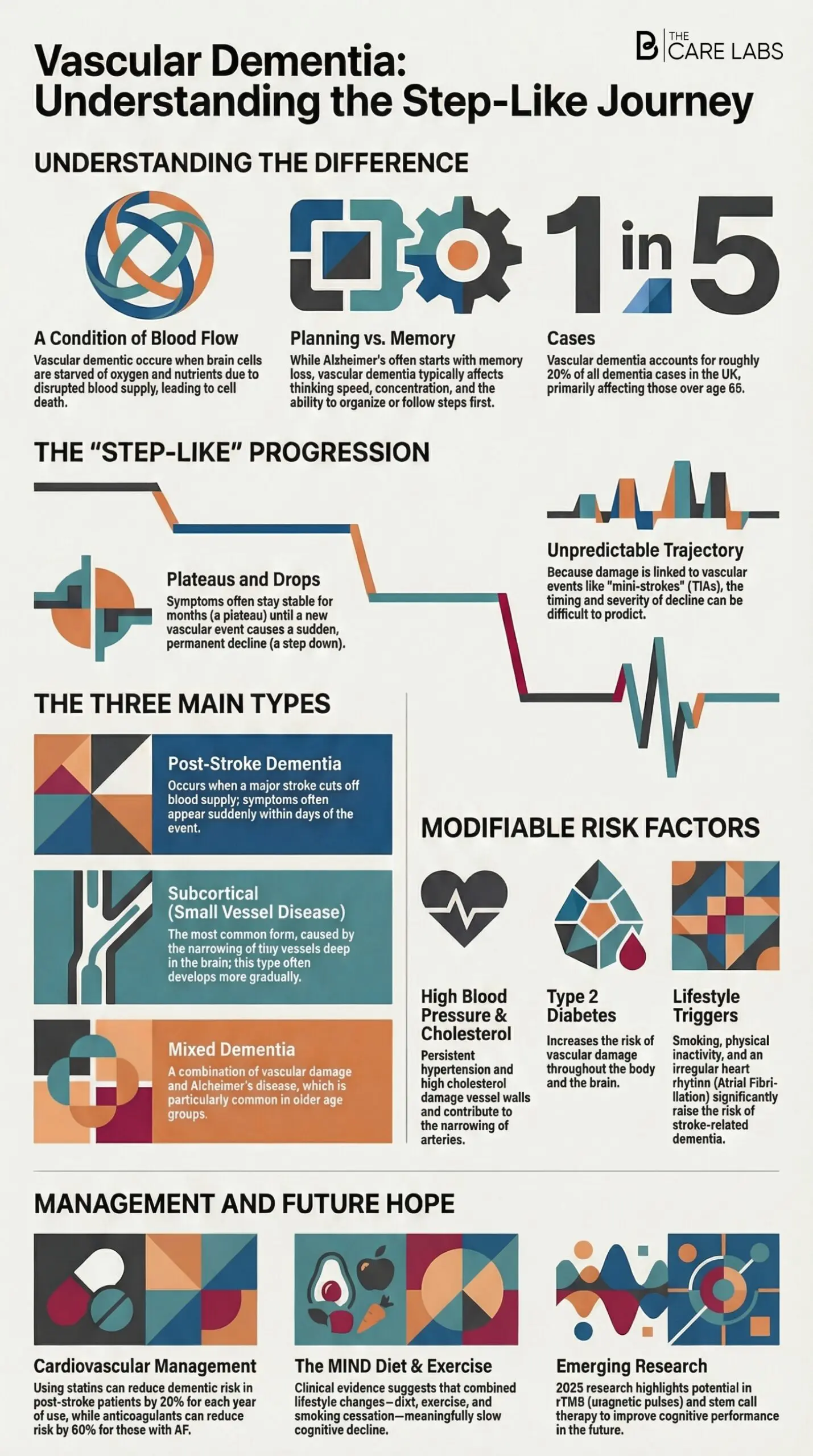
Vascular dementia is a form of dementia caused by reduced blood flow to the brain. When blood supply is disrupted, brain cells are starved of the oxygen and nutrients they need to function. Over time, those cells die, and the cognitive changes associated with dementia develop.
It is the second most common type of dementia in the UK, after Alzheimer’s disease. Around 180,000 people are currently living with the condition, according to the NHS.
Unlike Alzheimer’s, which tends to begin with memory difficulties and decline gradually over time, vascular dementia often affects thinking speed and planning more prominently in its early stages. It can also worsen in a more sudden, step-like pattern rather than a slow, continuous decline. Understanding this distinction is one of the most useful things families can know from the outset.
How common is vascular dementia in the UK?
Vascular dementia accounts for roughly one in five dementia cases in the UK, according to Alzheimer’s Research UK. It primarily affects people over 65, and the risk roughly doubles every five years from that point, according to the UK Dementia Research Institute. That said, it can affect younger people: around 8,000 people under 65 in the UK are currently living with the condition.
Men are generally thought to have a slightly higher risk, partly due to higher stroke rates. However, research pooling data from 2.3 million participants found that women with diabetes face a disproportionately greater risk of developing vascular dementia than diabetic men, highlighting that the picture is more nuanced than it first appears.
Types of vascular dementia
Not all vascular dementia is the same. There are three main types, each with a slightly different cause.
Post-stroke dementia
Around one in three people with vascular dementia have had a stroke. A stroke cuts off blood supply to part of the brain, causing immediate damage to that region. When this affects thinking and memory, the result is often called post-stroke dementia or, where multiple strokes are involved, multi-infarct dementia. Symptoms can appear suddenly, often within days of the stroke.
Subcortical vascular dementia (small vessel disease)
This is the most common form. It develops when small blood vessels deep inside the brain gradually narrow and restrict blood flow to the brain’s white matter: the network of fibres that connects different brain regions with each other. Unlike stroke-related dementia, this form may not produce obvious sudden symptoms at first. Instead, it tends to develop slowly, with thinking becoming gradually slower and less sharp over time.
Mixed dementia
Many people with vascular dementia also have Alzheimer’s disease alongside it. This is known as mixed dementia, and it is particularly common in older age groups. The presence of both conditions can make symptoms more varied and harder to attribute to a single cause. Treatment decisions may also differ slightly, since medications commonly used in Alzheimer’s care are not routinely recommended for pure vascular dementia alone.
Symptoms of vascular dementia
The symptoms of vascular dementia vary from person to person, depending on which parts of the brain have been affected. They can appear suddenly or build gradually over time.
Early symptoms often include:
- Slower thinking and difficulty concentrating
- Problems with planning, organising and decision-making
- Difficulty following a sequence of steps, such as cooking a familiar meal or managing a bank account
- Short periods of sudden confusion or disorientation
- Word-finding difficulties
- Changes in mood, personality or motivation, including depression, apathy or irritability
What makes vascular dementia clinically distinct from Alzheimer’s is that memory loss, while it can occur, is often not the most prominent early feature. Many people first notice a general slowing of thought, difficulty with tasks requiring forward planning, or changes in how quickly they can process information. This is one of the key things a specialist looks for when distinguishing vascular dementia from other types.
Physical symptoms can also be a distinguishing feature. Some people with vascular dementia experience problems with balance, a shuffling gait, or increased vulnerability to falls. These physical changes can develop alongside, or in some cases before, noticeable cognitive changes.
As the condition progresses, symptoms typically broaden to include:
- Greater memory difficulties and increasing confusion about time, place and familiar people
- Increasing difficulty finding words and communicating clearly
- Growing dependence with dressing, bathing and personal care
- Incontinence in later stages
- Behavioural changes including agitation, suspicion or hallucinations
If you’re trying to understand which symptoms are typical of dementia more broadly, our guide to Understanding Dementia: Symptoms and Diagnosis covers the wider picture.
How does vascular dementia progress?
This is one of the most important questions families ask, and the area where vascular dementia differs most clearly from other types.
Vascular dementia does not always follow the same steady, downward slope as Alzheimer’s disease. Instead, it often progresses in steps: a period of relative stability, followed by a sudden decline (often linked to another vascular event such as a small stroke or TIA), followed by another plateau. The NHS describes this as occurring ‘in sudden steps, with periods in between where the symptoms do not change much.’
This means a person with vascular dementia may cope reasonably well for months, then change significantly within days. For families, this can be disorienting and distressing, particularly when a shift seems to come from nowhere. Knowing the pattern in advance helps you plan more effectively and respond with more confidence when change does arrive.
The pattern is not the same for everyone. In cases driven primarily by small vessel disease, decline may be more gradual rather than step-like. In mixed dementia, the Alzheimer’s component adds a layer of continuous progression on top of the vascular steps.
A 2025 narrative review published in the journal Stroke and Vascular Neurology (Ng et al., 2025) highlighted that the overlapping nature of vascular damage makes predicting individual progression particularly challenging. The same review noted that while no treatment yet exists to reverse vascular dementia, research into novel approaches including brain stimulation therapies and early-stage stem cell treatment is actively moving forward. That is genuinely encouraging, even if those options are not yet part of standard care.
For a broader understanding of how dementia changes over time, our guide to the 7 Stages of Dementia: A Timeline for Carers explains the general trajectory in practical, accessible terms. While the stages framework was originally designed with Alzheimer’s in mind, it offers a useful reference point for understanding how care needs evolve at different points in the journey.
What causes vascular dementia?
Vascular dementia is caused by anything that reduces or disrupts blood flow to the brain. This can happen in several distinct ways:
- A stroke, where a blood clot or haemorrhage cuts off blood supply to a region of the brain
- A series of transient ischaemic attacks (TIAs or “mini-strokes”) that cause small but cumulative brain damage over time
- Small vessel disease, where tiny blood vessels deep inside the brain gradually narrow, typically as a result of conditions like high blood pressure or diabetes
Once blood flow is restricted, brain cells are deprived of oxygen and nutrients. Research increasingly shows that the damage doesn’t stop there. The 2025 Stroke and Vascular Neurology review by Ng and colleagues described a cascade of secondary effects that follow initial vascular injury: disruption to the blood-brain barrier, inflammation within the brain, and oxidative stress. These processes compound the original damage and help explain why the condition continues to progress even after the initial vascular event. It reinforces why managing cardiovascular health is so central to slowing vascular dementia, not just preventing it in the first place.
Risk factors for vascular dementia
Some risk factors cannot be changed. Age is the strongest: after 65, risk roughly doubles every five years. Genetics play a role too, particularly in rare inherited conditions such as CADASIL (caused by mutations in the NOTCH3 gene), though these are uncommon.
Most risk factors, however, are ones that can be managed or reduced. These include:
- High blood pressure (hypertension): one of the strongest modifiable risk factors, as persistent high pressure damages blood vessel walls over time
- High cholesterol: contributes to atherosclerosis, the narrowing and hardening of the arteries
- Type 2 diabetes: raises the risk of vascular damage throughout the body, including the brain
- Atrial fibrillation (AF): an irregular heart rhythm that increases the risk of stroke-related clots reaching the brain
- Smoking: directly damages blood vessels and significantly increases stroke risk
- Physical inactivity: linked to higher rates of all the above, and independently associated with faster cognitive decline
- Previous stroke or TIAs: having had a stroke or mini-stroke substantially raises the risk of vascular dementia
The encouraging finding from recent research is that many of these factors are treatable. Improvements in population cardiovascular health over recent decades are thought to be behind a gradual decline in vascular dementia incidence in Europe and North America. The disease is not inevitable.
How is vascular dementia diagnosed?
There is no single test for vascular dementia. Diagnosis involves a combination of:
- A detailed conversation with a GP about symptoms, their onset and how they are affecting daily life
- Referral to a memory clinic or specialist, typically a neurologist or old age psychiatrist
- Brain imaging, usually an MRI or CT scan, to look for stroke damage, white matter changes or small vessel disease
- Cognitive assessments that measure thinking speed, planning ability and memory
- Blood tests to identify contributing conditions such as high blood pressure, diabetes and high cholesterol
Getting an early diagnosis is worthwhile, even if it feels daunting. With a clearer picture of what is happening, treatment can be targeted more effectively, and families can begin planning with more confidence.
If you’d like more information on what the diagnostic process involves, our article on Understanding Dementia: Symptoms and Diagnosis walks through it in detail.
Treatment and management of vascular dementia
There is currently no cure for vascular dementia, and no treatment can reverse damage already done. However, there is a good deal that can be done to slow further progression and maintain quality of life.
Managing the underlying causes
Because vascular dementia is driven by cardiovascular disease, treating the conditions that damage blood vessels is the most effective tool available. This typically means:
- Blood pressure medication to reduce pressure on vessel walls
- Statins to lower cholesterol: a cohort study of over 14,000 post-stroke patients found that for each additional year of statin use, dementia risk fell by around 20% (Ng et al., 2025)
- Anticoagulants for people with atrial fibrillation: evidence suggests this can reduce dementia risk in AF patients by around 60%
- Blood glucose management for those with type 2 diabetes
Lifestyle adjustments
The evidence for lifestyle change is substantial. The 2025 Stroke and Vascular Neurology review found that stopping smoking, daily physical activity, and following a diet such as the MIND diet (which draws on Mediterranean and DASH dietary patterns) were all associated with slower cognitive decline in people with vascular risk factors. Targeting several lifestyle factors at once showed the greatest benefit.
Therapies and support
Cognitive stimulation therapy, group reminiscence activities and occupational therapy can support thinking skills and emotional wellbeing. These aren’t cures, but they can meaningfully improve day-to-day experience and help the person feel engaged and connected.
For mixed dementia (vascular dementia alongside Alzheimer’s), cholinesterase inhibitors such as donepezil or rivastigmine may be prescribed. The evidence for their use in pure vascular dementia is more limited, but they are often appropriate where both conditions are present.
What research is working on
The 2025 Stroke and Vascular Neurology review highlights two emerging approaches worth knowing about. Repetitive transcranial magnetic stimulation (rTMS), which uses targeted magnetic pulses to stimulate specific brain regions, has shown promising early results in improving cognitive performance in people with post-stroke cognitive impairment. Stem cell therapy is also being explored in early-stage clinical trials. Neither is a standard treatment yet, but both represent a genuine direction for the field. In the UK, the BHF and UK Dementia Research Institute jointly launched a dedicated Centre for Vascular Dementia Research in 2025, the first of its kind in the country.
What does day-to-day care look like?
For families, this is often the most pressing question. What will life actually look like?
In the earlier stages, many people with vascular dementia live relatively independently with some adjustments: routines that reduce cognitive load, written reminders, help with complex tasks like finances, and regular social contact. Keeping cardiovascular health on track remains a priority throughout.
As the condition progresses, more hands-on care becomes necessary. There may come a point where daily carer support, or a move to a specialist care environment, becomes the most appropriate option.
What tends to make the biggest difference, regardless of stage, is consistency: familiar environments, predictable routines, and carers who genuinely understand how vascular dementia behaves. Structure reduces anxiety. Familiarity provides comfort. And knowing that someone truly understands what is happening, not just physically but emotionally, makes a real difference to the person being cared for.
For families supporting someone at home, our Practical Guide to Caring for Someone with Dementia covers communication strategies, managing difficult days, and how to look after yourself as a carer.
When specialist residential care becomes the right step, our dementia care at Boutique Care Homes is designed around everything we know about what people with dementia need to feel safe, connected and comfortable.
Frequently asked questions
What is the difference between vascular dementia and Alzheimer’s disease?
Alzheimer’s disease is caused by the build-up of abnormal proteins in the brain, particularly amyloid plaques and tau tangles. It is caused by reduced blood flow and vascular damage. In practical terms, Alzheimer’s tends to begin with memory problems and progress gradually. Vascular dementia more commonly affects planning and thinking speed first, and can progress in sudden steps following vascular events. Many people have both conditions simultaneously, which is called mixed dementia.
Is vascular dementia hereditary?
Most cases are not directly inherited. The condition is driven mainly by cardiovascular risk factors, many of which are modifiable. However, rare genetic conditions such as CADASIL (caused by a mutation in the NOTCH3 gene) do cause inherited forms of this type of dementia. If there is a family history of early-onset vascular dementia, a GP can advise on whether genetic testing is appropriate.
How long do people live with vascular dementia?
There is no single answer. Life expectancy varies considerably depending on age at diagnosis, overall health, the type and extent of vascular damage, and how well cardiovascular risk factors are managed. As the NHS notes, vascular dementia can significantly shorten life expectancy, but many people live for several years with the condition, or die from an unrelated cause. Early and consistent management of cardiovascular risk factors is the most meaningful thing that can extend both length and quality of life.
Can vascular dementia be prevented?
Not entirely, but the risk can be meaningfully reduced. Keeping blood pressure controlled, stopping smoking, staying physically active, eating well, managing diabetes and cholesterol, and treating atrial fibrillation all reduce the risk of the vascular events that drive the condition. The gradual decline in rates seen across Europe and North America in recent decades is largely attributed to improvements in cardiovascular health at a population level.
What does step-like progression mean?
Rather than declining in a smooth, continuous way, people with vascular dementia often experience periods of relative stability punctuated by more sudden changes, usually following a vascular event such as a small stroke. After each step down, there may be another period of stability before the next change. This differs from Alzheimer’s, where decline tends to be more continuous. Not everyone follows this pattern: those with predominantly small vessel disease may decline more gradually.
What support is available in the UK?
Several specialist organisations offer free guidance and emotional support:
- Alzheimer’s Society Dementia Connect: 0333 150 3456
- Dementia UK Admiral Nurse Helpline: 0800 888 6678 (specialist dementia nurses, free and confidential)
- Age UK Advice Line: 0800 678 1602
- NHS memory clinics: your GP can refer you directly
Should someone with vascular dementia move to a care home?
This depends entirely on the individual’s needs, the pace of change, and the level of support available at home. Many people with vascular dementia live at home for a considerable time, often with carer support alongside them. When 24-hour specialist support becomes necessary, a specialist dementia care home can offer the structure, expertise and continuity of care that makes the biggest difference. This is not a decision to rush, and it doesn’t have to be made alone. Our team is happy to talk through your options without any pressure.
Sources
- Vascular dementia. https://www.nhs.uk/conditions/vascular-dementia/ Last reviewed June 2023.
- Alzheimer’s Society. What is vascular dementia? https://www.alzheimers.org.uk/about-dementia/types-dementia/vascular-dementia
- British Heart Foundation. Vascular dementia. https://www.bhf.org.uk/informationsupport/conditions/vascular-dementia Published March 2023.
- Alzheimer’s Research UK. What is vascular dementia? https://www.alzheimersresearchuk.org/news/vascular-dementia-explained/ Published November 2024.
- UK Dementia Research Institute. Vascular dementia. https://www.ukdri.ac.uk/conditions/vascular-dementia
- Ng S, Hornblass A, Habibi P, et al. Updates on vascular dementia. Stroke and Vascular Neurology. Published online February 2025. https://svn.bmj.com/content/svnbmj/early/2025/02/24/svn-2025-004048.full.pdf
Share this post




Other articles that you may like