



CQC Care Home Ratings: What Families Need to Know
CQC ratings tell you how a care home performed during its last inspection. The Care Quality Commission gives homes one of four ratings: Outstanding, Good, Requires Improvement, or Inadequate, based on five questions covering safety, effectiveness, care quality, responsiveness, and leadership. The rating is a useful starting point, but it reflects a snapshot in time and should not be your only check.
If you’ve been shortlisting care homes, you’ve probably noticed the CQC badge on almost every website. Most homes will say “Good.” A few will say “Outstanding.” And the natural question is: what do CQC care home ratings actually mean for your mum, your dad, or your loved one?
It’s a fair question, and one that rarely gets a straight answer. CQC care home ratings are widely displayed but poorly understood. This guide explains the system in plain English: what CQC is, how inspections work, what each rating means in practice, and what a rating can’t tell you.
What Is the CQC?
The Care Quality Commission (CQC) is the independent regulator of health and adult social care services in England. It registers, inspects, and rates care homes, hospitals, GP surgeries, and other care providers against national standards. If a service is failing, the CQC has the power to impose conditions, restrict admissions, issue warning notices, or close a home entirely.
The CQC covers England only. Scotland, Wales, and Northern Ireland have their own regulators.
Every registered care home in England must display its CQC rating at the entrance and on its website. This is a legal requirement, not optional.
What Are the Five Questions CQC Inspectors Ask?
During an inspection, the CQC assesses every service against five key questions. Each question gets its own individual rating, and these combine to produce the overall score. Understanding what each question actually means in practice is far more useful than reading the headline badge.
Safe: Are residents protected from abuse and avoidable harm?
Inspectors look at how the home manages risks, whether the team understand safeguarding, how incidents are reported and learned from, and whether medicines are handled correctly. In plain terms: are the doors secure, does the team know where every resident is, and are vulnerable people protected?
Effective: Does care achieve good outcomes and help residents maintain quality of life, based on best available evidence?
Inspectors check whether care plans are personalised and followed, whether nutrition and hydration needs are met, and whether residents are supported to stay as independent as possible. For families with a loved one living with dementia, this is often the most telling question. Our guide on how to choose a care home for a loved one living with dementia covers what to look for specifically.
Caring: Does the team treat residents with compassion, kindness, dignity, and respect?
This is assessed through inspector observations, conversations with residents and families, and reviewing how the team interact with people in their care. It’s the question families often describe as “the feel of the place” when they visit, and it can’t be faked over a sustained inspection.
Responsive: Are services organised to meet individual needs?
Inspectors look at whether residents can choose their own routines, how the home handles complaints, and whether care is genuinely personalised. Families often describe this as wanting to know: will they treat your mum as a person, not a room number?
Well-led: Does leadership create a culture of high-quality, person-centred care?
Inspectors look at management quality, how concerns are raised and acted on, whether the home learns from incidents, and the financial stability of the organisation. This question matters more than most families realise. A well-led home with strong values will perform well even under pressure. A poorly led home can decline quickly, regardless of the badge on the wall.
What Do the Four CQC Ratings Mean?
After inspecting against the five questions, the CQC assigns one of four overall ratings.
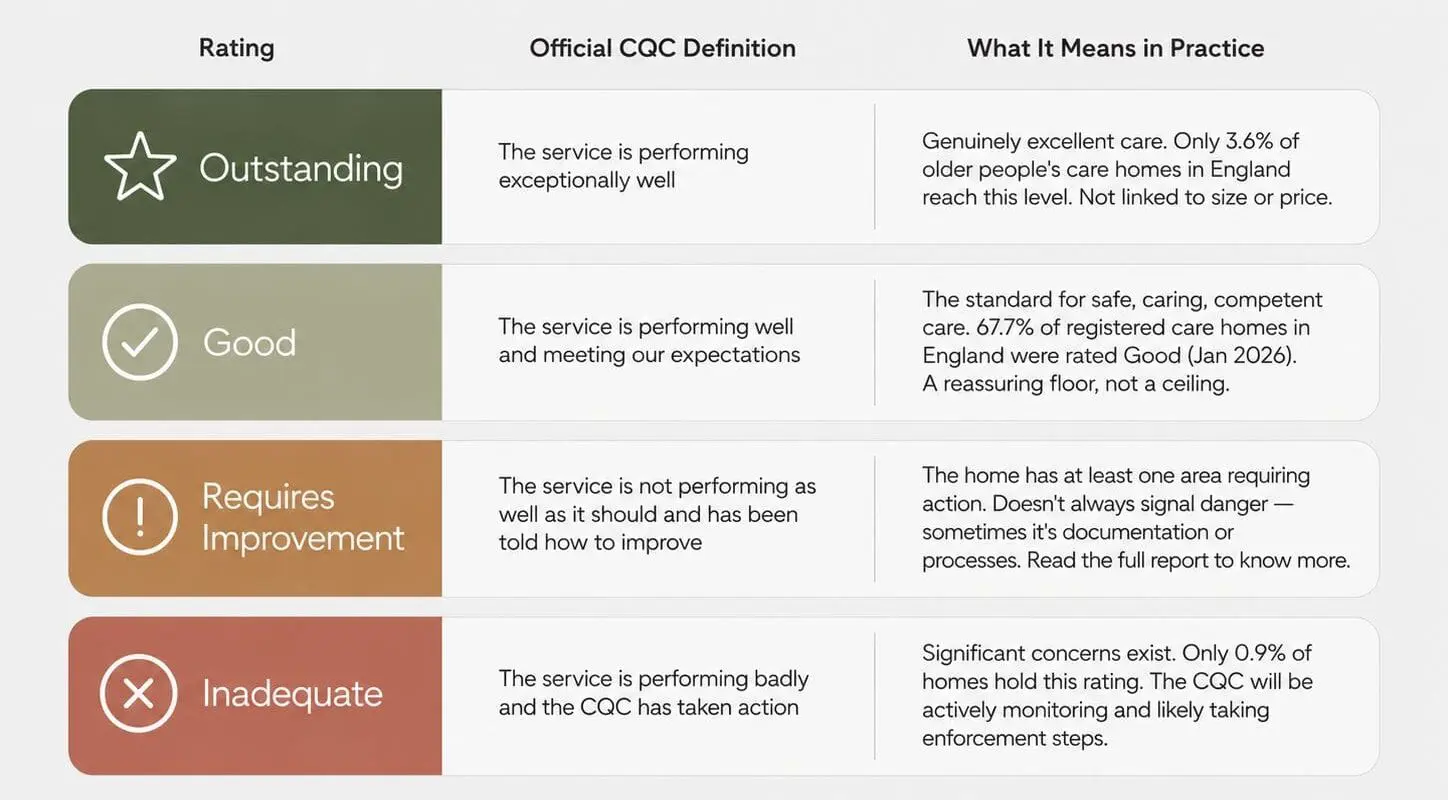
In total, as of 30 January 2026, there were 14,736 registered care homes in England: 548 Outstanding, 9,980 Good, 2,053 Requires Improvement, 128 Inadequate, and 2,027 not yet rated (carehome.co.uk, citing CQC register, January 2026).
The CQC introduced a new Single Assessment Framework (SAF) in January 2024, which uses percentage scoring alongside the four headline ratings. Not all homes have been assessed under the new framework yet, so you may encounter ratings from either system when researching.
Research published by the National Institute for Health and Care Research (NIHR) has confirmed that residents’ quality of life is measurably better in homes rated Good or Outstanding. That validates the rating as a meaningful signal. But Good is a starting point for your search, not the end of it.
What Does ‘Registered But Not Yet Rated’ Mean?
When you search for a care home on the CQC website, you may occasionally see a service described as registered but not yet rated. As of January 2026, 2,027 of the 14,736 registered care homes in England fell into this category (carehome.co.uk, citing CQC register, January 2026).
This usually means the home is newly opened. The CQC page for such a service will typically include a note along the lines of: “This service was registered by CQC on [date]. New services are assessed to check they are likely to be safe, effective, caring, responsive, and well-led.”
This registration assessment is not the same as a full published inspection. The CQC checks that a new service meets the basic conditions required to operate, but there is no inspection narrative, no resident feedback, and no track record to read.
For families considering a newly registered home, this matters. You are relying more heavily on what you see during your visit, your conversations with the registered manager, and any early reviews or word of mouth. Ask directly when the home expects its first full CQC inspection, and what internal quality monitoring is in place in the meantime. A home that is well-run from day one will have clear answers to both questions.
How Do I Find a Care Home’s CQC Report?
The rating badge is easy to find. The full report takes slightly more effort but is well worth reading.
- Go to The CQC Website
- Click “Find care services” and select Care homes
- Search by the home’s name, location, or postcode
- Click on the home to see the overall rating and the individual ratings for each of the five questions
- Click “All inspection reports and timeline” to read the full written report
This step matters most. The headline badge gives you a summary. The report narrative gives you the real picture: specific observations, quotes from residents and family members, what went well, what didn’t, and any requirements the home was given.
A home with four Good CQC care home ratings and one Requires Improvement needs a close look at exactly which question fell short, and whether it has been addressed. The words in the report will tell you far more than the numbers.
How Current Is a Care Home’s CQC Rating?
This is the part most guides on CQC care home ratings don’t address. And it matters enormously.
Inspection frequency is based on a home’s current rating:
- Outstanding: At least every 2.5 years
- Good: At least every 2 years
- Requires Improvement: Within 12 months
- Inadequate: Within 6 months
The CQC can also carry out unannounced inspections at any time if concerns are flagged by the public, team members, or whistle-blowers.
In practice, the CQC has faced a significant inspection backlog. A BBC News investigation in November 2024 found that the average age of published CQC care home ratings had nearly doubled, from roughly two years in 2020 to roughly four years by 2024. The same investigation found that at least one care home rated Good had not been inspected for seven years (BBC News, November 2024, citing GOV.UK data).
This has real consequences for families. A rating reflects who was running the home and how it was performing at the time of the last inspection, not necessarily today. Management changes, ownership changes, and pressures on the team can all shift a home’s culture significantly between inspections.
The same is true in the other direction: a home currently rated Requires Improvement may have addressed the issues in full but not yet received its follow-up inspection.
A practical check to add to your process: When you review a CQC report, note the inspection date clearly. If it was more than two years ago, factor that into how much weight you give the rating. Ask the home directly when they last had an inspection and whether they are expecting one. A confident, well-run home will welcome the question.
What Doesn’t a CQC Rating Tell You?
A CQC care home rating is a regulatory snapshot. It is not a measure of everything families care about most when choosing a home.
It does not tell you:
- Whether the home has warmth and life, or feels quiet and institutional
- Whether team members stay long enough to build genuine relationships with residents
- Whether the food is good, or whether residents are actually enjoying mealtimes
- Whether residents are engaged and occupied, or sitting in front of a television all day
- Whether the culture and management have changed since the last inspection
- Whether the home is the right fit for your loved one’s specific personality, history, and needs
Families who have been through the process say this clearly. One wrote in the Alzheimer’s Society support forum: “Dad’s first home had a Good report but actually it didn’t provide the kind of care for our Dad that was needed, part of the reason we moved.” Another observed that some homes divert funds to presentation, “nice paintwork, fresh flowers, restaurant-style menus,” while the quality of actual care comes off worst (Alzheimer’s Society Forum, August 2025).
The CQC rating gives you an important quality check. A visit gives you something the rating cannot: the feel of the place, how the team talk to and about residents, whether your loved one’s face relaxes when they walk in, or tenses up. Our guide on questions to ask when visiting a care home covers exactly what to look for beyond the inspection report.
How to Use a CQC Rating When Choosing a Care Home
Think of the rating as the first step in a four-step process, not the whole process.
Step 1: Filter Start by setting a baseline. Most families are comfortable shortlisting Good and Outstanding homes. If you’re considering a Requires Improvement home, read the report carefully and understand what needs to change. If you’re not sure where to begin with the search itself, our complete guide to choosing a care home takes you through the full process.
Step 2: Read the full report For every home you’re seriously considering, go beyond the badge. Read the inspection narrative on cqc.org.uk. Look for the language the inspector used, the specific requirements made, whether there are recurring themes across multiple inspections, and whether residents and families spoke positively in quoted feedback.
Step 3: Check the date and ask the question Note when the inspection was carried out. If it was more than two years ago, ask the home when the next inspection is expected and whether anything significant has changed in management or ownership since.
Step 4: Visit and trust your instincts No rating replaces walking through the door. Bring a prepared list of questions. Notice the small things: how the team greet you, whether residents seem settled and engaged, whether the home smells clean, and whether you feel comfortable asking awkward questions. If the rating is Good but the visit doesn’t feel right, trust that instinct.
If costs are part of the conversation at this stage, which they often are, our breakdown of care home costs in the UK explains what to expect and what funding support may be available. And if you’re still working out whether the time is right to be looking at care homes at all, our guide on when it might be time for a care home covers the signs families often look back on and recognise.
Frequently Asked Questions
What does a Good CQC rating mean for a care home?
A Good rating means the Care Quality Commission found the home to be performing well and meeting national standards across all five key questions, covering safety, effectiveness, care quality, responsiveness, and leadership, during its last inspection. It is the most common rating: 67.7% of care homes in England were rated Good as of January 2026 (carehome.co.uk, citing CQC register, 2026). Good is a meaningful quality signal, but it is a baseline. The quality of life within a Good-rated home will vary, and the visit, not just the badge, is what tells you whether it’s the right fit.
How often does the CQC inspect care homes in England?
Outstanding-rated homes should be inspected at least every 2.5 years. Good-rated homes at least every 2 years. Requires Improvement homes within 12 months. Inadequate homes within 6 months. The CQC can also conduct unannounced inspections at any time if concerns are raised by the public, team members, family members, or commissioners. In practice, a significant inspection backlog means some homes are rated under inspections that are 3 to 4 years old on average (BBC News / GOV.UK, November 2024).
How do I find a care home’s CQC rating and report?
Go to CQC, click “Find care services,” and search by the home’s name, location, or postcode. You can view the overall rating and the individual ratings for each of the five key questions, and read the full written inspection report. All care homes in England are legally required to display their CQC care home ratings at their entrance and on their website. The full report, not just the badge, is where the real detail lives.
Can I complain to the CQC about a care home?
You can share concerns with the CQC, and they may use your information to inform a future inspection decision. However, the CQC does not investigate individual complaints or resolve disputes between families and care providers. If you have a concern about a specific home, the first step is to raise it directly with the home’s manager. If it isn’t resolved, you can escalate to the Local Government and Social Care Ombudsman, who does investigate individual complaints.
What is the difference between Outstanding and Good in a CQC inspection?
An Outstanding rating means the home is performing exceptionally well, going significantly beyond the standard in a way the CQC considers remarkable. A Good rating means the home is meeting national expectations competently across all five questions. Only 3.6% of older people’s care homes in England are rated Outstanding (carehome.co.uk, January 2026). Both ratings reflect safe, regulated care. Outstanding homes typically show stronger person-centred practice, innovative approaches, and particularly strong leadership that sets the culture of the whole home.
Should I rule out a care home rated Requires Improvement?
Not automatically. Requires Improvement means the home must address at least one area of concern, but this doesn’t always signal a safety risk. Sometimes the issues involve documentation, record-keeping, or specific processes rather than direct care. Read the full inspection report on cqc.org.uk to understand exactly what is failing. Also check when the inspection was carried out: a home rated Requires Improvement two years ago may have addressed the problems in full but not yet been reinspected. Asking the home directly about their progress is entirely reasonable.
How do I read a CQC inspection report properly?
Don’t stop at the headline rating. Click through to the full report on cqc.org.uk. Look at the individual ratings for each of the five key questions. Read the narrative sections, which include inspector observations, direct quotes from residents and family members, specific requirements or recommendations made to the home, and any enforcement actions taken. Experienced families in the Alzheimer’s Society forum consistently advise reading the words, not just the scores: “the words paint a picture which is far more informative than just the ratings” (Alzheimer’s Society Forum, August 2025).
Can a care home’s CQC rating go down?
Yes. If a home’s standard of care deteriorates, the CQC can downgrade its rating following a reinspection or an unannounced visit. The CQC can also take enforcement action, including imposing conditions on registration, restricting the number of residents a home can accept, issuing warning notices, or in serious cases cancelling a home’s registration entirely. When a home is placed into special measures, the CQC monitors it closely and publishes regular updates. This is one reason why a recent inspection date is more reassuring than a high rating alone.
A Useful Starting Point, Not the Whole Picture
CQC care home ratings give you a regulated, independent quality check on every care home in England. They matter, and they are worth understanding properly before you visit.
But they are a starting filter, not a final verdict. The most important information comes from the full inspection report, the date it was carried out, the visit itself, and the conversations you have with the team and residents when you walk through the door.
If you’re working through this process and finding it harder than you expected, that’s a completely normal experience. Our complete guide to choosing a care home covers every stage from initial research to moving in day. And if you’d like to talk through your options with people who understand the care journey, the team at Boutique Care Homes is always happy to have a conversation, with no pressure and nothing to sell.
For more guides and resources for families navigating care, visit The Care Labs.
Sources
- Care Quality Commission — The five key questions we ask
- Care Quality Commission — Our ratings and scores
- Care Quality Commission — How we inspect adult social care services
- carehome.co.uk — CQC ratings breakdown (citing CQC register, January 2026)
- BBC News — Care home ratings out of date as CQC faces inspection backlog (November 2024)
- National Institute for Health and Care Research (NIHR) — CQC rating linked to better quality of life for care home residents
- Age UK — Choosing a care home
- Alzheimer’s Society Dementia Support Forum — Questions to ask when visiting care homes (July–August 2025)
Other articles that you may like